
Finding a baby bird on the ground does not always mean it needs rescuing. Many young songbirds leave their nests before they can fly well, and their parents continue feeding and protecting them.
The first step is determining whether the bird is a nestling, a fledgling, or an adult. Its age, condition, and circumstances will help determine whether intervention is necessary.
Nestlings
How to recognize them: Nestlings are very young birds that are naked, partially feathered, or covered in developing feathers. Their eyes may be closed or open, depending on their age. They are not yet ready to leave the nest and depend on their parents for warmth, food, and protection.
When to leave them alone: A healthy nestling in an intact nest should be left undisturbed. Parent birds may be away gathering food and do not remain with their young continuously.
When they need help: A nestling found on the ground needs assistance because it is not yet capable of surviving outside the nest. A bird that is injured, cold, weak, covered with insects or fly eggs, or has been caught by a cat or dog requires professional attention.
What to do: If the nestling appears healthy and its original nest is accessible, gently return it to the nest. It is a myth that parent birds will reject their young because a person has touched them.
If the entire nest has fallen, and the birds appear healthy, the nest may be placed back in its original location if it can be secured safely.
If the original nest is damaged or cannot be replaced, a small plastic basket or similar container with drainage holes may sometimes be used as a substitute nest. Secure it near the original nesting location, protected from direct sun and rain, and place the original dry nesting material inside when possible.
Observe from a distance where the parents cannot see you. Parent birds may hesitate to return while people remain nearby. If the parents resume caring for the nestlings, no further intervention is necessary.
If the parents do not return after an appropriate observation period, or if the birds appear cold, weak, or injured, contact a wildlife rehabilitator for guidance. Do not attempt to feed the birds or give them water.
Good to know: Songbird nestlings grow rapidly. Depending on the species, many leave the nest within approximately two weeks of hatching. Their parents continue providing food and care as they develop.
Fledglings
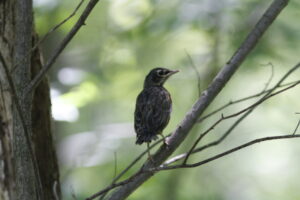 How to recognize them: Fledglings are young birds that have left the nest but are not yet strong or experienced flyers. They are usually mostly feathered, have their eyes open, and may hop, flutter, perch on low branches, or call repeatedly for food.
When to leave them alone: A healthy fledgling hopping on the ground or sitting on a low branch is usually behaving normally. Its parents are often nearby, bringing food and watching over it.
Do not attempt to return a healthy fledgling to its nest. Leaving the nest is a normal stage of development, and the bird may simply jump out again.
When they need help: A fledgling that is visibly injured, bleeding, unable to stand or balance, unusually weak, or has been caught or carried by a cat or dog needs professional attention.
What to do: If the fledgling is healthy but in immediate danger, such as on a roadway or in an area accessible to pets, it may be moved a short distance to a nearby shrub or low branch where its parents can find it.
Keep cats and dogs indoors and ask children to avoid the area while the fledgling develops its flying skills. Watch from a distance if you are concerned about parental care.
If the bird is injured or has had contact with a cat or dog, contact a wildlife rehabilitator promptly. Even tiny puncture wounds can cause serious infections.
Good to know: Fledging is a natural and often awkward stage of a songbird’s development. Young birds improve their flying abilities through practice while their parents continue feeding them. Depending on the species, this period may last several days or longer.
Adult Songbirds
When to leave them alone: Healthy adult songbirds are alert, responsive, and able to move or fly normally. Birds resting quietly, feeding on the ground, or sheltering in vegetation do not necessarily need assistance.
When they need help: Adult songbirds are commonly injured by window collisions, vehicle strikes, and attacks by domestic cats. A bird that cannot fly, has a drooping wing, is bleeding, has difficulty standing, or appears disoriented needs professional assessment.
A bird that has struck a window may have a concussion or other serious injuries even when no wounds are visible. Birds caught by cats require prompt professional care because puncture wounds may be difficult to see and can lead to life-threatening infection.
What to do: If the bird can be safely contained, place it in a ventilated cardboard box with a secure lid, following our general Wildlife Rescue Guidelines. Keep the box in a dark, quiet location away from children and pets.
Do not attempt to feed the bird, give it water, or encourage it to fly. Contact a wildlife rehabilitator promptly, especially after a window collision or cat attack.
Good to know: Songbirds face many hazards in developed areas. Reflective windows can appear to be open sky or vegetation, causing birds to collide with the glass. Outdoor cats also pose a significant threat to wild birds, even when the cats are well fed.
Need Help With a Songbird?
If you find a songbird that appears injured, sick, or genuinely orphaned, contact Wildlife in Need Emergency Response of Pennsylvania (WIN) at 814-414-4224, between 8 a.m. and 6 p.m., most days.
For general information about recognizing wildlife emergencies and safely assisting injured animals, visit our Wildlife Rescue Guidelines page.